

Every ESS EV battery terminal post application demands robust, reliable electrical connections that handle high continuous currents, withstand constant vibration, and survive harsh environmental conditions. The terminal post — the physical interface where power enters and exits the battery — ranks as one of the most critical components in the entire system. Therefore, selecting the right ESS EV battery terminal post directly impacts system safety, efficiency, and service life.
This ESS EV battery terminal post application guide explains how LYD engineers IP67 waterproof rectangular terminal posts for demanding battery systems. Specifically, it covers the key specifications you should evaluate when specifying connector components for your next energy storage or electric vehicle project.
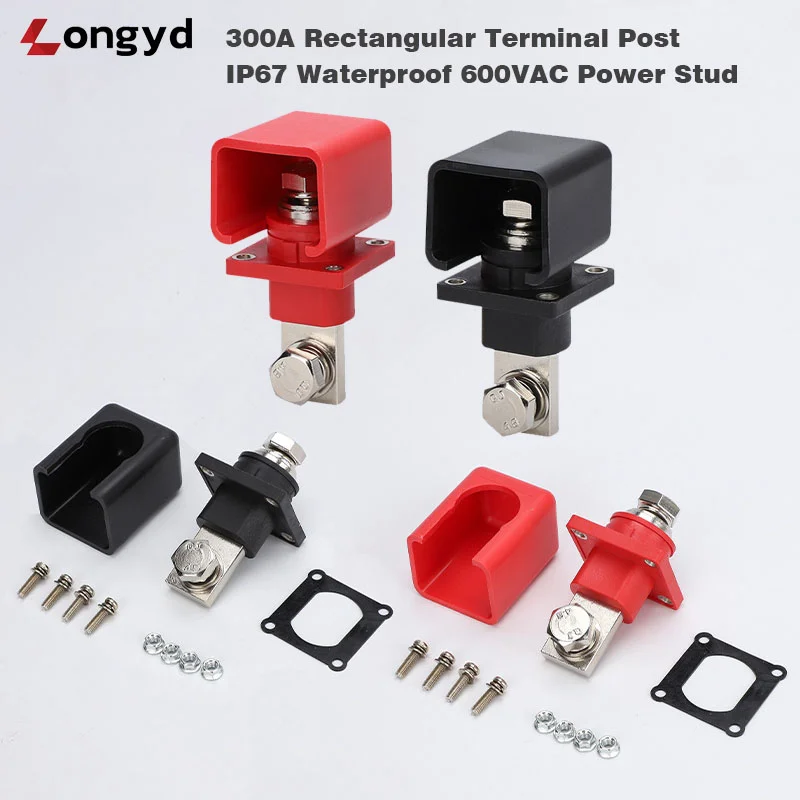
Why ESS EV Battery Terminal Post Selection Matters
In a typical ESS installation, the battery bank connects to an inverter, charge controller, and load distribution panel. Every interface in this chain introduces resistance. A poorly selected ESS EV battery terminal post can cause several serious problems. First, voltage drop reduces system efficiency. Second, heat generation accelerates insulation aging and creates fire risk. Third, corrosion increases contact resistance over time. Consequently, the connection may fail entirely under sustained load.
Beyond these direct electrical effects, mechanical failure poses another threat. Thermal cycling and vibration can loosen connections over time. Since ESS and EV systems operate for 10-20 years, the terminal post must maintain consistent performance across thousands of charge-discharge cycles. Notably, many field failures in battery systems trace back to a single degraded connection point.
ESS EV Battery Terminal Post Application Range from LYD
LYD offers five terminal post models covering 120A to 400A continuous current ratings. Each model targets specific ESS and EV use cases. The table below summarizes the available options:
| Model | Best For | Key Feature |
|---|---|---|
| 120A Terminal Post | Home ESS, small UPS systems | Cost-effective entry-level IP67 protection |
| 150A Terminal Post | Medium battery packs, solar storage | Balanced performance and cost for residential systems |
| 200A Busbar Terminal Post | Commercial ESS, busbar distribution | A-type and C-type connection options for flexibility |
| 300A Power Terminal Post | Large-scale ESS, EV charging stations | High current capacity with IP67 sealing reliability |
| 400A Square Terminal Post | Industrial ESS, high-voltage battery systems | 1000VAC rating with square busbar form factor |
Furthermore, all five models come as red (+) and black (-) paired sets. This color coding reduces the risk of reverse polarity connection during installation — a critical safety consideration in high-voltage ESS and EV systems above 60V DC.
Key Technical Requirements for ESS EV Battery Terminal Post Applications
ESS battery systems place unique demands on connection components. Unlike consumer electronics connectors, an ESS EV battery terminal post must satisfy multiple engineering requirements simultaneously. Below we examine the three most critical specifications.
1. High Continuous Current Handling for ESS EV Applications
ESS batteries sustain charge or discharge currents for extended periods — sometimes for hours during peak shaving or backup operations. Unlike intermittent-duty connectors, the terminal post must maintain low contact resistance under continuous load without overheating. LYD’s terminal posts use high-purity nickel-plated copper conductors with generous cross-sectional area to minimize resistive losses. As a result, the 120A model stays below 30°C temperature rise at full rated current, while higher-rated models maintain proportionally low thermal profiles.
2. IP67 Environmental Protection for Battery Terminal Posts
Outdoor ESS cabinets and automotive battery enclosures face rain, condensation, and washdown procedures. An IP67-rated terminal post ensures moisture cannot wick into the battery terminals. Moreover, the compression-fit silicone O-ring seal prevents water ingress while maintaining sealing pressure under thermal expansion and contraction. Per the IEC 60529 standard, IP67 certification guarantees dust-tight sealing and protection against temporary immersion in 1 meter of water for 30 minutes.
3. Mechanical Robustness in EV Battery Terminal Post Applications
EV battery packs experience constant vibration during vehicle operation. The terminal post’s mounting flange design, combined with the UL94 V-0 PA66 housing, provides the mechanical strength needed for dynamic conditions. Specifically, the PA66 material offers high dimensional stability from -40°C to +105°C. This ensures the silicone O-ring maintains consistent compression force regardless of ambient temperature swings. For additional safety assurance, many ESS systems reference the UL 1973 standard for battery energy storage system safety.
ESS EV Battery Terminal Post Application: A-Type vs C-Type Connections
LYD offers two connection interface options across the terminal post range. Choosing the right type depends on your system architecture and assembly requirements.
A-Type Busbar Connection for ESS EV Battery Terminal Posts
The A-Type terminal features a flat rectangular busbar interface. It accepts bolted connections to copper or aluminum busbars. This design suits distribution panels where multiple connections must daisy-chain together. Consequently, A-Type terminal posts work well in containerized ESS installations where busbar distribution provides the backbone for battery rack interconnection.
C-Type Cable Lug Connection for EV Battery Terminal Post Applications
The C-Type terminal accepts ring terminals and battery cable lugs. This connection style is common in EV battery packs where flexible cables connect directly to cell terminals or module outputs. Since EV battery packs change shape slightly under thermal cycling and acceleration forces, the flexible cable connection helps absorb movement without stressing the terminal interface.
Polarity Safety: Color Coding for ESS EV Battery Terminal Posts
All LYD terminal post models ship as red (+) and black (-) paired sets. This polarity color coding reduces the risk of reverse polarity connection during installation. In high-voltage ESS and EV systems — typically 400-800V DC — a reverse polarity mistake can cause catastrophic damage. Therefore, the color coding serves as a simple but essential safety measure during field assembly and maintenance.
Performance Data: ESS EV Battery Terminal Post Application Case Study
A 500 kWh commercial ESS cabinet deployed LYD 300A terminal posts for battery-to-inverter connections. The installation operated in a humid coastal environment with daily charge-discharge cycling. After 18 months of continuous operation, the system reported zero connector-related issues. The IP67 sealing prevented condensation ingress despite the high-humidity conditions. Additionally, periodic contact resistance measurements showed no measurable increase from the initial installation baseline.
This field data confirms what lab testing predicts: the nickel-plated copper conductor maintains stable contact resistance over extended service periods. For ESS and EV system designers choosing between connector options, documented real-world reliability adds confidence to the selection process.
Complementary Components for ESS EV Battery Terminal Post Applications
Beyond rectangular terminal posts, LYD offers complementary connection components that work alongside the terminal post series. For signal-level connections in battery management system (BMS) wiring, the IP67 waterproof M12 PCB-mount connector provides reliable sensor and data interfaces with the same environmental protection rating. Furthermore, the full IP67 waterproof connector product line includes multiple form factors suitable for auxiliary power and control wiring within ESS and EV battery enclosures.
OEM Customization for ESS EV Battery Terminal Post Applications
LYD supports full OEM customization for battery pack and ESS manufacturers. Available customizations include alternative terminal lengths, different plating options (tin or silver plating), and bulk packaging for production-line assembly. If your project requires non-standard dimensions or specific plating chemistry, contact nick.xu@lyd123.com to discuss your requirements. The engineering team can adjust the ESS EV battery terminal post design to match your enclosure panel thickness, mounting hole pattern, and current-carrying requirements.
Selecting the Right ESS EV Battery Terminal Post Application
Select the correct terminal post by evaluating three primary factors. First, calculate your maximum continuous operating current and add a 25% safety margin. Second, determine whether your system needs A-type busbar connectivity or C-type cable lug compatibility. Third, verify that the IP67 sealing rating matches your environmental exposure conditions.
For example, a home ESS with a 10 kW inverter typically draws around 80A at 48V DC. The 120A terminal post provides adequate headroom. Conversely, a commercial ESS cabinet handling 100 kW at 400V DC requires the 300A or 400A terminal post depending on peak current profiles. Since many ESS installations expand capacity over time, choosing a terminal post with current headroom avoids costly retrofits later.
FAQ: ESS EV Battery Terminal Post Application Questions Answered
What current rating suits my ESS EV battery terminal post application?
Select a terminal post rated at least 125% of your maximum continuous operating current. This provides a thermal safety margin for load variability and ambient temperature effects. For systems operating above 40°C internal enclosure temperature, apply additional derating. LYD offers models from 120A for home ESS systems up to 400A for industrial installations.
Can one ESS EV battery terminal post serve both ESS and EV applications?
Yes. The same LYD terminal post models work for both stationary ESS and mobile EV battery applications. All models carry IP67 environmental protection, UL94 V-0 flame-retardant housings, and nickel-plated copper conductors. However, EV applications may benefit from the C-type (cable lug) interface for flexible cable routing, while ESS installations often use the A-type (busbar) interface for rigid distribution panel connections.
What certifications cover LYD ESS EV battery terminal post applications?
LYD terminal posts carry IP67 ingress protection per IEC 60529, UL94 V-0 flame retardancy for the PA66 housing material, and 1000VAC dielectric strength ratings on the 400A model. For ESS-specific safety compliance, many customers reference UL 1973 and UL 2580 as part of their system-level certification process.
How do you install an ESS EV battery terminal post correctly?
First, cut a rectangular mounting hole in your panel according to the product datasheet dimensions. Second, insert the terminal post through the hole from the outside. Third, tighten the mounting nut to the specified torque (typically 8-12 N·m depending on the model). The silicone O-ring compresses evenly around the mounting hole circumference to create the IP67 watertight seal. Finally, connect your busbar or cable lug and torque the terminal nut to the specified value. Over-torquing can damage the PA66 housing, so use a calibrated torque wrench.
What temperature range applies to ESS EV battery terminal posts?
LYD terminal posts operate reliably from -40°C to +105°C. The PA66 housing maintains dimensional stability across this full range, while the silicone O-ring retains its elastic recovery properties even at extreme low temperatures. For applications near the upper temperature limit, derate the continuous current rating by approximately 0.5% per °C above 40°C ambient. Contact our engineering team for specific thermal derating calculations for your operating conditions.
Conclusion: Choosing the Right ESS EV Battery Terminal Post
The ESS EV battery terminal post application demands careful specification across current rating, environmental protection, connection type, and mechanical durability. LYD’s IP67 waterproof rectangular terminal post series addresses these requirements through nickel-plated copper conductors, silicone O-ring compression seals, UL94 V-0 PA66 housings, and comprehensive color-coded polarity marking. Whether you design a small home ESS or a multi-megawatt industrial battery system, selecting the correct terminal post ensures reliable, long-term performance.
For application-specific engineering support, thermal derating calculations, or custom terminal post configurations, contact LYD’s engineering team at nick.xu@lyd123.com. Explore the complete terminal post range starting from the 120A entry-level model up to the 400A industrial-grade terminal post.
Related Resources: Browse LYD’s full range of high-current connection solutions — including IP67 waterproof connectors and IP67 M12 PCB-mount connectors for BMS and auxiliary systems.
