

In energy storage and EV power systems, the terminal post forms the critical current interface between the battery pack and the load. Unfortunately, moisture, dust, or corrosive environments can turn a single connection failure into a system-wide safety hazard. This is why IP67 waterproof terminal posts now serve as the engineering standard for professional-grade ESS and EV applications.
Engineers need IP67-rated terminal post connectors that maintain a dust-tight, water-immersion-proof seal while carrying 200A to 400A continuously. Moreover, these connectors must perform across temperature extremes, survive vibration, and endure thousands of thermal cycles. This technology deep-dive examines the engineering behind LYD’s IP67 waterproof terminal post series. Specifically, you will learn about the sealing architecture, material science, plating technology, validation testing, and real-world deployment across energy storage and electric vehicle applications.
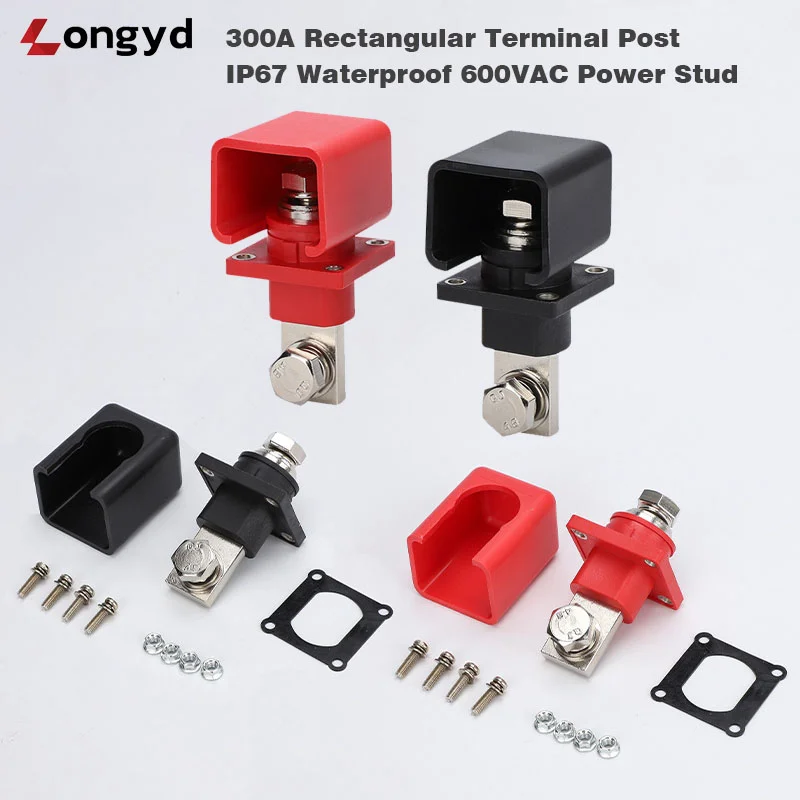
Understanding IP67 Waterproof Terminal Post Protection
The international standard IEC 60529 defines the IP (Ingress Protection) rating system. Consequently, this standard provides the benchmark for waterproof terminal post performance. In particular, an IP67 waterproof terminal post delivers two critical protection levels:
- IP6_ (First Digit — Dust Protection): Dust-tight. No ingress of dust particles. Complete protection against airborne contaminants. This matters for outdoor solar inverters, wind turbine converters, and mining equipment where fine particulate is constant.
- IP_7 (Second Digit — Water Immersion): Protection against temporary immersion. The connector withstands submersion in 1 meter of water for up to 30 minutes without leakage. Even flooded battery compartments, heavy washdown environments, or marine installations cannot disrupt operation.
For deeper context, the IEC provides the full IP rating standard (IEC 60529) documentation.
Sealing Architecture of IP67 Waterproof Terminal Posts
LYD’s rectangular terminal posts achieve IP67-level sealing through a precision-engineered multi-layer design. Specifically, each layer serves a distinct function within the overall waterproof barrier system. Ultimately, the interaction between these layers determines long-term field reliability.
Compression Fit Sealing Mechanism
The primary waterproof barrier uses a precision-molded silicone O-ring. During installation, engineers seat this O-ring between the terminal post base and the panel mounting surface. Then, when you torque the mounting nut to specification (8-12 N·m depending on model), the O-ring compresses evenly around the entire mounting hole. As a result, this creates a watertight barrier. Crucially, this seal remains stable under thermal expansion and contraction.
We selected silicone for this application for three specific reasons. First, its excellent elastic recovery maintains seal pressure over thousands of thermal cycles. Second, the wide operating temperature range spans -40°C to +105°C. Third, silicone resists ozone and UV degradation — an essential trait for outdoor-deployed waterproof terminal posts.
Material Compatibility for Long-Term Sealing
Beyond the O-ring itself, the nickel-plated copper conductor and PA66 housing both resist moisture absorption and electrochemical corrosion. Therefore, this material compatibility protects seal integrity over the product’s full service lifetime. Notably, no degradation pathway emerges from material incompatibility between the seal, housing, and conductor.
Material Selection in IP67 Waterproof Terminal Post Technology
Engineers design every component in an IP67 waterproof terminal post for a specific function. The material choices directly determine the electrical performance, mechanical durability, and environmental resilience:
| Component | Material | Engineering Function |
|---|---|---|
| Conductor | High-Purity Copper, Nickel-Plated | Nickel plating prevents oxidation. Maintains low contact resistance (<0.1 mΩ) even in 95% RH environments. High-purity copper ensures maximum conductivity with minimal I²R losses. |
| Housing / Insulator | PA66 Nylon, UL94 V-0 Rated | Excellent dielectric strength (>15 kV/mm). Flame retardancy to UL94 V-0. Dimensional stability across -40°C to +105°C. |
| Mounting Hardware | Steel, Zinc-Plated or Stainless Steel (SS304) | Corrosion-resistant fasteners prevent galvanic corrosion at the panel interface. Users can choose the stainless steel option for marine-grade installations. |
| Sealing Element | Silicone O-Ring | High elastic recovery. Wide temperature tolerance. Ozone/UV resistance. Shore A 60-70 durometer for optimal compression set. |
Why Nickel-Plated Copper in Waterproof Terminal Posts?
Meanwhile, the conductor material plays a decisive role in the long-term reliability of an IP67 waterproof terminal post. Consequently, LYD uses high-purity copper with nickel plating across all IP67 terminal post models (200A, 300A, 400A). Specifically, three critical requirements drive this selection:
Corrosion Barrier Protection
Bare copper oxidizes rapidly in humid or salty environments, forming a non-conductive cuprous oxide (Cu₂O) layer. In turn, this layer increases contact resistance and generates localized hot spots. Nickel plating provides a stable, conductive surface that resists oxidation at up to 400°C. Furthermore, it maintains low contact resistance even after extended 95% relative humidity or salt spray exposure. For reference, the ASTM B117 salt spray standard defines the testing methodology engineers use to validate this performance.
Wear Resistance in High-Cycle Applications
Nickel achieves a Vickers hardness of 150-200 HV compared to 50-90 HV for pure copper. As a result, this higher surface hardness reduces galling and abrasive wear during repeated mating and unmating cycles. Modular battery systems, for example, require periodic reconfiguration. In these high-cycle applications, nickel plating extends the service life of the contact interface. You can learn more about plating technologies through the Nickel Institute‘s engineering resources.
Long-Term Solderability of Nickel-Plated Terminals
Nickel-plated surfaces remain solderable over extended storage periods. In contrast, bare copper quickly develops a non-solderable oxide layer after weeks of ambient exposure. This difference matters significantly for IP67 waterproof terminal posts in field-assembled systems, because the time between factory production and on-site installation may span several months.
Current Rating Guide for IP67 Waterproof Terminal Posts
LYD’s IP67 waterproof terminal post series covers three standard current ratings, and each model serves specific application requirements. Most importantly, selecting the correct current rating ensures adequate safety margin and proper thermal management:
| Model | Rated Current | Conductor Type | Typical Application |
|---|---|---|---|
| IP67 200A Terminal Post | 200A continuous | Rectangular, nickel-plated copper | Outdoor telecom cabinets, small-scale solar inverters |
| IP67 300A Terminal Post | 300A continuous | Rectangular, nickel-plated copper | Marine energy storage, mid-scale ESS containers |
| IP67 400A Terminal Post | 400A continuous | Rectangular, nickel-plated copper | Utility-scale ESS, EV fast-charging infrastructure |
Real-World Applications for IP67 Waterproof Terminal Posts
IP67-rated waterproof terminal posts suit a wide range of demanding environments. In each application below, reliable high-current connections are non-negotiable because system uptime depends on them:
- Energy Storage Systems (ESS): 400A rectangular terminal posts provide the primary DC busbar interface in containerized battery storage. IP67 protection ensures reliable operation in outdoor, unconditioned environments.
- Electric Vehicle Power Systems: 300A waterproof terminal posts serve EV battery pack terminals. Vibration, thermal cycling, and potential road spray exposure demand robust sealing.
- Telecom Power Cabinets: 200A busbar terminal posts function as the primary DC input/output interface in outdoor telecom rectifier cabinets. 24/7 uptime depends on connection integrity in all weather conditions.
- Marine & Offshore: Salt spray exposure and high humidity require IP67 waterproof terminal posts with stainless steel hardware. This prevents galvanic corrosion at the panel mounting interface.
Testing and Validation for Waterproof Terminal Post Technology
Every IP67 terminal post model in LYD’s product line undergoes a comprehensive validation program. Specifically, this program verifies performance under real-world conditions. Engineers designed the testing protocol to simulate the combined stressors that waterproof terminal posts encounter during field deployment:
- IP67 Immersion Test (IEC 60529): 1 meter water depth and 30 minutes continuous submersion. Post-test dielectric measurement confirms zero moisture ingress.
- Dielectric Strength Test: AC 2000V applied for 60 seconds between conductor and mounting flange. This confirms insulation integrity after thermal and mechanical stress.
- Thermal Cycling Test: -40°C to +105°C ramp across 100 complete cycles. This verifies dimensional stability and sealing performance across the full operating envelope.
- Salt Spray Corrosion Test (ASTM B117): Minimum 72 hours at 35°C with 5% NaCl fog. Nickel-plated surfaces and hardware must show no red rust or functional degradation.
Frequently Asked Questions About IP67 Waterproof Terminal Posts
What sets IP67 terminal posts apart from IP68-rated options?
IP67 terminal posts handle temporary immersion at 1 meter depth for up to 30 minutes. In contrast, IP68-rated connectors must withstand continuous submersion beyond 1 meter. The manufacturer specifies the exact depth and duration for IP68 ratings. However, for most ESS and EV applications, IP67 provides sufficient protection. Instead, engineers typically reserve IP68 for permanently submerged uses like subsea equipment or deep-underground installations.
Can IP67 waterproof terminal posts withstand high vibration?
Yes. The compression-fit O-ring sealing mechanism resists vibration inherently. Because the mounting nut torque holds constant sealing pressure regardless of external vibration, the seal never relaxes. Moreover, nickel-plated copper conductors resist fretting corrosion. Consequently, LYD’s IP67 waterproof terminal posts work reliably in EV and heavy machinery applications where continuous vibration forms part of the design conditions.
How should I select a terminal post current rating?
First, choose a terminal post with a rating at least 125% of your maximum continuous operating current. This accounts for load variability and provides a thermal safety margin. Also consider the ambient temperature at the installation location. Then apply derating factors if the terminal post operates above 40°C ambient. Finally, refer to the Current Rating Guide above for a detailed model-by-model comparison.
What maintenance do IP67 waterproof terminal posts need?
Under normal operating conditions, IP67 waterproof terminal posts function as maintenance-free components. However, we still recommend periodic visual inspection of the mounting interface. Specifically, check for seal deformation, corrosion at fastener points, or loosening of the mounting nut. For aggressive environments like offshore or chemical processing sites, we recommend an annual inspection cycle.
Do LYD IP67 terminal posts work with busbar and lug terminations?
Yes. The rectangular conductor geometry on LYD’s 200A–400A IP67 terminal posts works with standard copper busbars, ring terminals, and compression lugs. The nickel-plated surface ensures low-resistance contact with any mating conductor type. For specific torque values and lug sizing, consult the individual product datasheets. Alternatively, contact our engineering team directly.
Conclusion: Choosing the Right IP67 Waterproof Terminal Posts
In summary, LYD’s 200A–400A series IP67 waterproof terminal post technology combines four engineering pillars. First, IEC 60529-certified multi-layer sealing with silicone O-ring compression fit. Second, nickel-plated copper conductors for oxidation-resistant, low-resistance current transfer. Third, UL94 V-0 flame-retardant PA66 housings for electrical safety across temperature extremes. Finally, comprehensive validation testing that spans immersion, thermal cycling, salt spray, and dielectric strength tests.
Choosing the right waterproof terminal post technology directly impacts system uptime, maintenance burden, and total cost of ownership. This holds true whether you design outdoor telecom cabinets, marine energy storage containers, or EV battery pack interfaces. For application-specific engineering support, thermal derating calculations, or custom configurations, contact LYD’s engineering team.
Related Resources: Explore LYD’s complete range of high-current connection solutions — from IP67 waterproof connectors to IP67 M12 PCB-mount connectors for signal and low-power applications.
