

This IP67 power terminal post selection guide helps you choose the right high current IP67 power terminal post is critical for the safety, reliability, and efficiency of your energy storage system (ESS), electric vehicle battery pack, or industrial power distribution equipment. With current ratings ranging from 120A to 400A and IP67 waterproof protection, the wrong power terminal post selection can lead to overheating, voltage drop, or premature failure.
In this IP67 power terminal post selection guide, we compare LYD’s full range of rectangular terminal posts — 120A, 150A, 200A, 300A, and 400A — to help engineers and procurement professionals make an informed decision for their high current applications. For a focused technical comparison of terminal post types, see our application guide for ESS and EV battery systems.
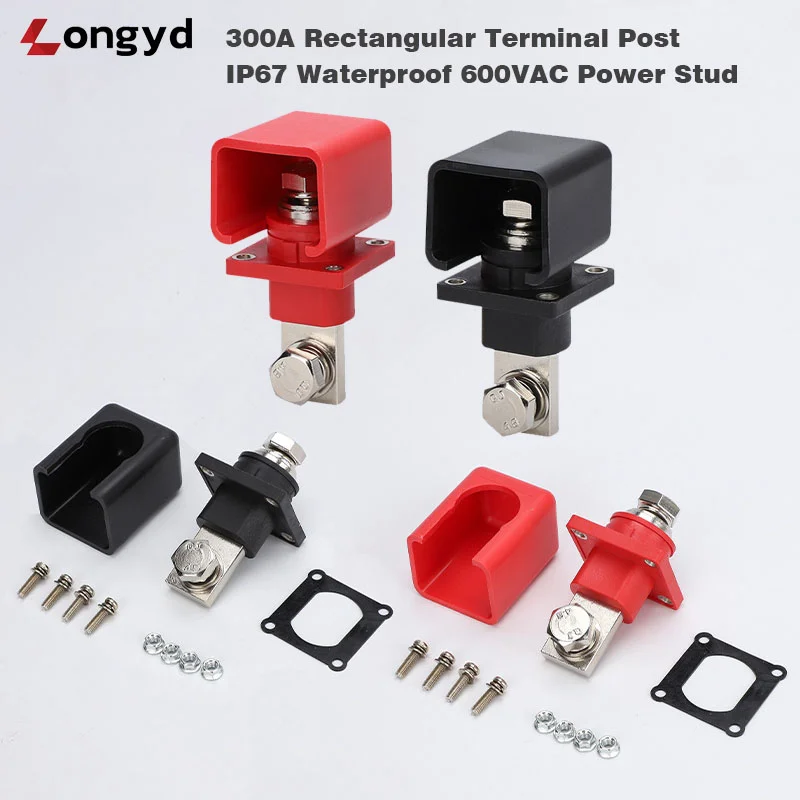
IP67 Power Terminal Post Selection Guide: At a Glance
| Model | Current Rating | Voltage Rating | IP Rating | Material | Typical Application |
|---|---|---|---|---|---|
| 120A Terminal Post | 120A | 600VAC | IP67 | Nickel-plated Copper | Small ESS, UPS backup |
| 150A Terminal Post | 150A | 600VAC | IP67 | Nickel-plated Copper | Medium battery packs, inverters |
| 200A Busbar Terminal Post | 200A | 600VAC | IP67 | Nickel-plated Copper | Busbar systems, power distribution |
| 300A Power Terminal Post | 300A | 600VAC | IP67 | Nickel-plated Copper | Large ESS, EV charging stations |
| 400A Square Terminal Post | 400A | 1000VAC | IP67 | Nickel-plated Copper | High-power ESS, industrial rectifiers |
Key Selection Factors for Your IP67 Power Terminal Post
1. Current Rating — The First Step in Power Terminal Post Selection
The most important parameter when making a power terminal post selection is the continuous current rating. Always select a terminal post rated at least 20% above your system’s maximum expected current to provide a safety margin. For example, a 150A system should use the 200A model for reliable long-term operation. This derating practice is recommended by industry standards such as UL 1977 for component connectors used in data and power applications.
2. Voltage Rating — Consider Your DC Bus Voltage
Similarly, all models in this high current IP67 series are rated for 600VAC, with the 400A model offering an upgraded 1000VAC rating — ideal for high-voltage ESS installations and solar-plus-storage systems. When designing for 800V EV battery architectures or utility-scale energy storage, the 1000VAC rating provides critical headroom.
3. IP67 Waterproofing — Critical for Power Terminal Selection in Harsh Environments
Furthermore, all five IP67 power terminal post models feature full IP67 protection per IEC 60529, meaning they are dust-tight and can withstand immersion in 1 meter of water for 30 minutes. This makes them suitable for outdoor battery cabinets, marine power systems, and industrial washdown areas where moisture resistance is non-negotiable.
4. Terminal Type — Busbar vs Cable Lug Connection
- A-Type (Rectangular Busbar): Best for bolted busbar connections in distribution panels and battery module interconnects — offers the lowest contact resistance for high current paths.
- C-Type (Cable Lug): Designed for standard ring terminals and battery cable lugs — preferred when flexible cable routing is needed between battery racks or inverter cabinets.
IP67 Power Terminal Post Selection by Application
| Application | Recommended Model | Why |
|---|---|---|
| Home ESS / Small UPS | 120A or 150A | Cost-effective for low-to-medium power systems |
| Commercial ESS / Solar Storage | 200A or 300A | Handles higher charge/discharge rates |
| Industrial UPS / Data Center Power | 300A or 400A | High reliability for critical infrastructure |
| EV Charging Station Infrastructure | 400A | 1000VAC rating supports future high-voltage systems |
Additionally, for systems operating above 200A continuous current, we recommend using the IP67 power terminal post selection guide above in combination with a thermal analysis of your busbar or cable assembly to ensure the entire current path is properly rated.
What Makes an IP67 Power Terminal Post: Materials and Compliance
- Housing: PA66 Nylon, UL94 V-0 flame retardant
- Conductor: High-purity copper with nickel plating for corrosion resistance — critical for maintaining low contact resistance over the product’s lifetime in high current applications
- Sealing: Integrated silicone O-ring for IP67 protection, tested per IEC 60529
- Color Coding: Red (+) and Black (-) pairs for polarity identification, reducing installation errors
- RoHS Compliant: Full compliance with EU environmental directives
IP67 Power Terminal Post FAQ: Common Selection Questions
What is the difference between a terminal post and a busbar?
A terminal post is a discrete connection point typically mounted on a battery or device, while a busbar is a metallic strip used for distributing power across multiple connection points. Our 200A model combines both functions as a busbar-integrated terminal post.
Can I use a 600VAC terminal post in a 400VDC system?
Yes. AC voltage ratings generally translate to higher DC voltage capability due to the absence of zero-crossing arc extinction requirements. A 600VAC rated terminal post is suitable for 400VDC battery systems with appropriate safety margins.
How do I verify the IP67 seal integrity after installation?
After torquing the terminal post to the specified value (consult the product datasheet), we recommend a visual inspection of the O-ring seating and a continuity check. For mission-critical installations, a dielectric withstand test per IEC 60529 is advised.
Why choose nickel-plated copper over tin-plated terminals for high current?
Nickel plating offers superior corrosion resistance, higher temperature tolerance (up to 200°C), and lower contact resistance over time compared to tin plating, especially in high-temperature high current IP67 environments.
Are these terminal posts compatible with aluminum cables?
While designed primarily for copper conductors, our nickel-plated copper terminals can be used with aluminum cables when proper bi-metallic washers are employed to prevent galvanic corrosion. Contact our engineering team for specific recommendations.
Need Help with Your Power Terminal Post Selection?
Contact our engineering team at nick.xu@lyd123.com with your system specifications — including max continuous current, operating voltage, ambient temperature, and mounting configuration — and we will recommend the optimal high current IP67 power terminal post configuration for your project.
Related guides: High-Current Terminal Posts for ESS and EV Battery Systems | How to Install IP67 Power Terminal Posts
