

L-Shaped Cable Assemblies
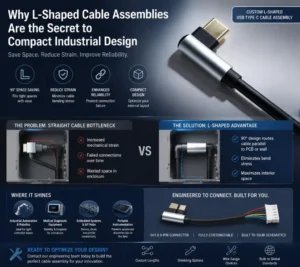
L-Shaped Cable Assemblies : In the world of hardware engineering, space is often the most valuable commodity. Whether you are designing a high-end medical device, an industrial automation controller, or a sleek consumer gadget, the internal layout is always a battle against physical constraints.
If you have ever struggled with cable strain or connector clearance issues, it is time to reconsider your cable management strategy. Our custom L-Shaped Cable Assemblies & USB-C2.0/3.0/3.1 is more than just a connection point—it is a design solution.
The Problem: The “Straight-Cable” Bottleneck
Standard straight-plug cables are the culprits behind many common design failures. When a device requires a low-profile footprint, a straight connector often forces the cable to bend sharply against the chassis. This leads to:
- Increased mechanical strain: Constant pressure on the internal solder joints.
- Failed connections: Signal degradation over time due to bending stress.
- Wasted space: The need for extra depth in the enclosure to accommodate the cable’s bend radius.
The Solution: The L-Shaped Advantage
By integrating an L-shaped USB Type-C connector, you gain immediate control over your interior architecture. The 90-degree geometry allows the cable to run parallel to the PCB or device wall, effectively eliminating the “bend zone” that causes hardware failures.
Where Our Cable Assemblies Shine
This specific wire harness, featuring the reliable SH1.0 9-pin connector, is engineered for mission-critical applications:
- Industrial Automation & Robotics: Perfect for tight controller boxes where multiple components share the same physical footprint.
- Medical Diagnostic Equipment: Provides the stability and longevity required for high-frequency use in compact medical diagnostic tools.
- Embedded Systems & IoT Hubs: Essential for devices where internal board-to-board connectivity must be secure, clean, and low-profile.
- Portable Instrumentation: The right-angle design prevents accidental disconnections during field usage, ensuring your device remains operational when it matters most.
Designed for Customization
We understand that no two engineering projects are the same. That is why our cable assemblies are fully customizable. From wire gauge and shielding density to the specific length required to bridge your internal components, we build to your schematics.
As modern hardware continues to push the boundaries of miniaturization—following global standards set by bodies like the USB-IF—having a flexible, robust, and space-efficient connection partner is crucial to your success.
Ready to optimize your internal connectivity? Stop forcing standard cables into custom spaces. Contact our engineering team today to discuss your project’s requirements, and let us help you design a cable assembly that fits your innovation perfectly.
Frequently Asked Questions
What is an L-shaped cable assembly?
An L-shaped (right-angle) cable assembly features a 90-degree bend at the connector interface. This design allows cables to run flush along surfaces, reducing stress on the connector and saving space in compact enclosures.
When should I use an L-shaped USB cable instead of a straight one?
Use L-shaped cables when your device has limited clearance behind the port, such as wall-mounted displays, embedded panels, or tight control cabinets. They reduce cable bend radius and prevent connector damage from repeated strain.
Are L-shaped cables available in USB 3.0 or USB-C?
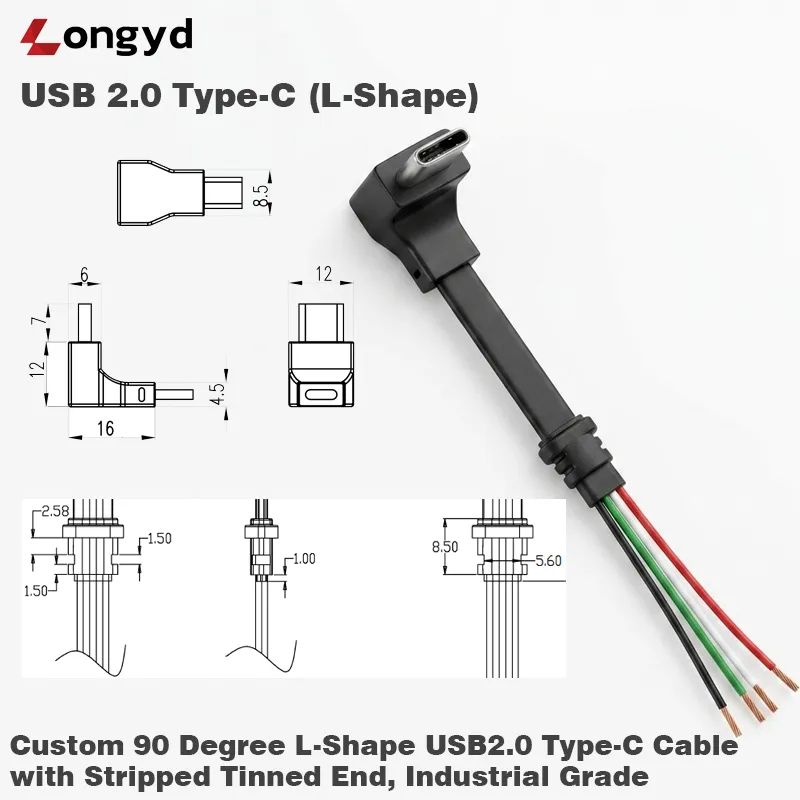
Yes. Longyueda offers L-shaped USB 3.0 and USB-C cable assemblies for industrial applications. Our USB 3.0 Type-C L-Shape to SH1.0 9-Pin supports high-speed data transfer while maintaining a compact right-angle footprint.
Can L-shaped cables be customized for specific lengths and connectors?
Absolutely. All L-shaped cable assemblies can be fully customized: wire gauge, length, connector type, and pin assignment. Contact our engineering team with your requirements for a tailored solution.
🔧 Download L-Shaped Cable Datasheet & Request Custom Samples →
For more right-angle solutions, explore our USB-C side entry receptacle blog and wire-to-board connector guide.
