

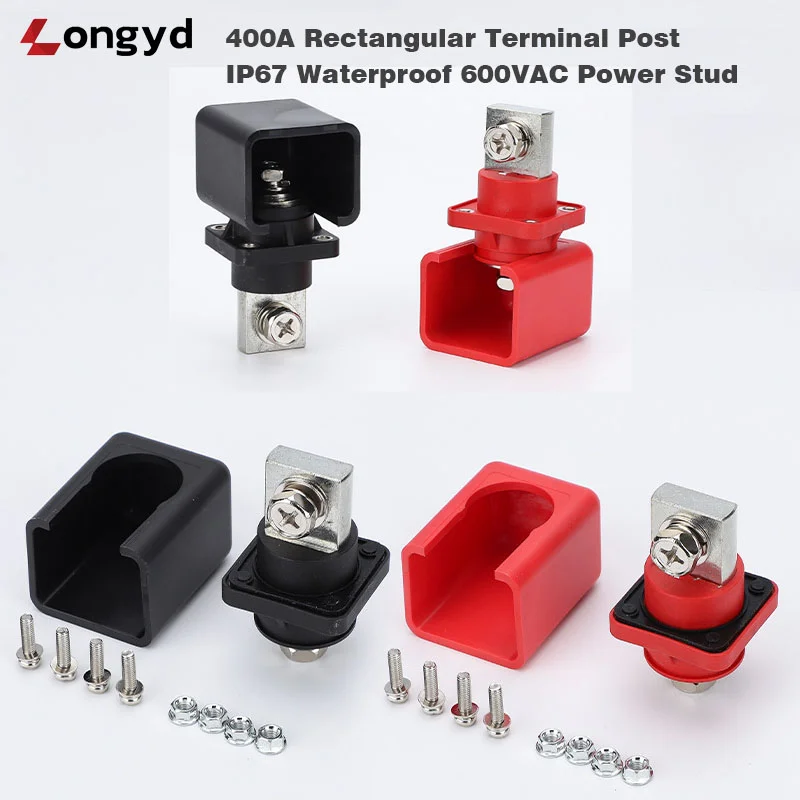
Introduction: The Growing Demand for High-Current Energy Storage Connectors
As the global energy storage market expands—driven by renewable energy integration, electric vehicle adoption, and grid-scale battery systems—the need for reliable, high-current interconnect solutions has never been greater. Energy storage systems (ESS) and EV battery packs demand connectors that can handle continuous currents of 80A to 200A or more, while maintaining IP67 waterproof protection in harsh operating environments.
LYD’s Quick-Lock energy storage connector series (200A and 80A models) addresses these challenges with a silver-plated copper contact system, IP67-rated sealing, and a tool-less quick-lock mating mechanism designed for field installation and maintenance.
Key Specifications: 200A and 80A Energy Storage Connectors
200A Energy Storage Connector
- Current Rating: 200A continuous
- Voltage Rating: 1000VDC
- Ingress Protection: IP67 (mated)
- Contact Material: Silver-plated copper
- Mating Style: Quick-lock (tool-less)
- Color Options: Orange / Black (polarity-coded pairs)
- Applications: ESS battery racks, EV battery packs, industrial power storage
80A Energy Storage Connector
- Current Rating: 80A continuous
- Voltage Rating: 1000VDC
- Ingress Protection: IP67 (mated)
- Contact Material: Silver-plated copper
- Mating Style: Quick-lock (tool-less)
- Color Options: Orange / Black (polarity-coded pairs)
- Applications: Residential ESS, light EV, UPS battery systems
Quick Selection Guide: 200A vs 80A
| Parameter | 200A Model | 80A Model |
|---|---|---|
| Continuous Current | 200A | 80A |
| Peak Current (10s) | 300A | 120A |
| Voltage Rating | 1000VDC | 1000VDC |
| Recommended Cable | 2/0 AWG (70mm²) | 4 AWG (25mm²) |
| Typical System | Grid-scale ESS, EV traction battery | Residential ESS, UPS, light EV |
| Mating Cycles | ≥500 | ≥500 |
| Operating Temperature | -40°C to +105°C | -40°C to +105°C |
Why Choose Quick-Lock Over Traditional Bolt-On Connections?
1. Installation Efficiency
Traditional battery terminal connections require torque wrenches, threaded fasteners, and multiple assembly steps. The Quick-Lock mechanism reduces installation time by up to 70%, enabling faster system assembly and lower labor costs—critical for high-volume ESS production lines.
2. Consistent Contact Pressure
Unlike bolted connections where contact resistance varies with torque accuracy, the Quick-Lock design delivers repeatable, factory-calibrated contact pressure. This ensures consistent electrical performance across every connection point in the system.
3. Field-Serviceable Design
When battery modules need replacement or maintenance, the Quick-Lock connector can be disconnected and reconnected without tools—no risk of over-torquing, stripped threads, or uneven compression. This is a significant advantage for ESS installations where modules are swapped periodically.
IP67 Waterproof Protection for Harsh Environments
Both the 200A and 80A energy storage connectors feature integrated IP67 sealing when mated. This means they are:
- Dust-tight: Complete protection against dust ingress (fine particles, dirt, debris)
- Waterproof: Protected against temporary immersion in water up to 1 meter depth for 30 minutes
For ESS installations in outdoor containers, coastal environments, or industrial facilities with wash-down requirements, IP67-rated connectors are essential for long-term reliability.
Silver-Plated Copper: Why Material Choice Matters
The choice of silver-plated copper contacts is not arbitrary:
- Low Contact Resistance: Silver offers the lowest electrical resistivity among common plating materials, minimizing I²R losses at high currents
- Corrosion Resistance: The silver layer protects the copper substrate from oxidation, maintaining low contact resistance over the product lifecycle
- High-Temperature Performance: Silver-plated contacts maintain stable performance at elevated operating temperatures typical of high-current connections
Compared to nickel plating (common in terminal posts), silver plating provides approximately 5-8% lower contact resistance, making it the preferred choice for Quick-Lock connectors where plug-in mating requires minimal insertion force while maximizing conductivity.
Thermal Management Considerations
At 200A continuous current, even a contact resistance of 0.1 mΩ generates 4 watts of heat (I²R = 200² × 0.0001). In enclosed battery compartments, this heat must be managed to prevent thermal runaway. LYD’s Quick-Lock connectors address this through:
- Silver-plated contacts: Minimizing contact resistance to reduce I²R heating at the source
- Large conductor cross-section: Providing effective heat dissipation from the contact interface to the cable
- PA66 housing with UL94 V-0 rating: Ensuring flame-retardant containment even under fault conditions
For installations in high-ambient environments (above 40°C), we recommend applying a derating factor of 0.8× to the continuous current rating or consulting LYD’s engineering team for application-specific thermal analysis.
Applications in Energy Storage and EV Systems
Grid-Scale ESS Battery Racks
Utility-scale energy storage systems use multiple battery modules connected in series and parallel. The 200A energy storage connector is ideal for rack-level interconnections where high current capacity and reliable waterproof sealing are required.
Commercial & Industrial ESS
C&I energy storage systems—used for peak shaving, backup power, and renewable integration—benefit from the 80A connector’s balance of current capacity and compact form factor.
Electric Vehicle Battery Packs
In EV battery pack assembly, both 200A and 80A connectors serve as module-to-busbar interfaces, providing reliable connections that withstand vibration, thermal cycling, and moisture exposure.
Comparing to Other High-Current Solutions
| Feature | LYD Quick-Lock Connector | Traditional Bolt Terminal | Anderson-Style Connector |
|---|---|---|---|
| Installation Time | ~10 seconds (tool-less) | ~60 seconds (wrench required) | ~20 seconds (manual) |
| Contact Pressure Consistency | Factory-calibrated (repeatable) | Torque-dependent (variable) | Spring-loaded (good) |
| IP Rating | IP67 (mated) | N/A (requires boot) | Varies by model |
| Voltage Rating | 1000VDC | 600V typical | 600V typical |
| Field Serviceability | Tool-less disconnect | Tool required | Manual disconnect |
Installation Best Practices
- Cable Preparation: Use appropriately rated cable (e.g., 2/0 AWG for 200A, 4 AWG for 80A). Strip insulation carefully to avoid nicking conductors.
- Crimp Quality: Use a calibrated crimping tool with the correct die for silver-plated copper contacts. Perform pull-test verification per UL 486A.
- Polarity Verification: Orange = Positive (+), Black = Negative (-). Always verify polarity before mating to prevent reverse-connection damage.
- Mating Confirmation: Ensure the Quick-Lock mechanism engages fully—audible click indicates proper mating. Visually confirm the latch is seated.
- Routine Inspection: Periodically check for signs of overheating (discoloration, melting) or corrosion, especially in high-humidity or salt-spray environments.
Frequently Asked Questions
Can the 200A connector be used for 150A applications?
Yes. The 200A Quick-Lock connector can be used at any current up to 200A continuous. Operating at 150A provides an additional thermal safety margin and is actually recommended for enclosed installations with limited ventilation.
What is the difference between silver-plated and nickel-plated contacts?
Silver plating offers approximately 5-8% lower contact resistance compared to nickel, making it ideal for plug-in Quick-Lock connectors. Nickel plating (used in LYD’s terminal post series) provides superior wear resistance for bolted connections with high mating cycles. Both meet IP67 standards when properly sealed.
Are the 200A and 80A connectors interchangeable?
No. The 200A and 80A models have different physical dimensions, cable entry sizes, and current ratings. They are designed for different system scales. The 80A is optimized for residential and light commercial ESS, while the 200A targets grid-scale and EV traction applications.
What cable sizes are compatible?
The 200A model accepts 2/0 AWG (70mm²) cable with the standard contact, and up to 4/0 AWG (120mm²) with optional larger contacts. The 80A model accepts 4 AWG (25mm²) standard, with optional 2 AWG contacts for longer cable runs. Always match the cable ampacity to local electrical codes.
How do Quick-Lock connectors perform under vibration?
The Quick-Lock mechanism includes a positive-locking latch that prevents accidental disconnection under vibration. Combined with silver-plated contacts that resist fretting corrosion, these connectors are suitable for EV battery packs and mobile ESS applications subject to continuous vibration per IEC 61373 Category 1 Class B.
Conclusion
The LYD Quick-Lock energy storage connector series (200A and 80A) offers a compelling combination of high-current capacity, IP67 waterproof protection, and rapid tool-less installation. For ESS integrators, EV battery manufacturers, and industrial power system designers, these connectors represent a significant improvement in installation efficiency and long-term reliability compared to traditional bolt-on solutions.
For detailed specifications, CAD drawings, and volume pricing, contact LYD’s engineering team or visit the product pages:
- 200A Energy Storage Connector IP67 Waterproof 1000VDC
- 80A Energy Storage Connector IP67 Waterproof 1000VDC
Related Resources
For a deeper technical analysis of waterproof sealing and material selection in high-current applications, read our IP67 Waterproof Terminal Post Technology Deep-Dive, covering the engineering behind nickel-plated copper conductors and silicone O-ring sealing architecture.
For signal-level waterproof connectivity, explore our M12 Right Angle PCB Mount Connector Guide.
