

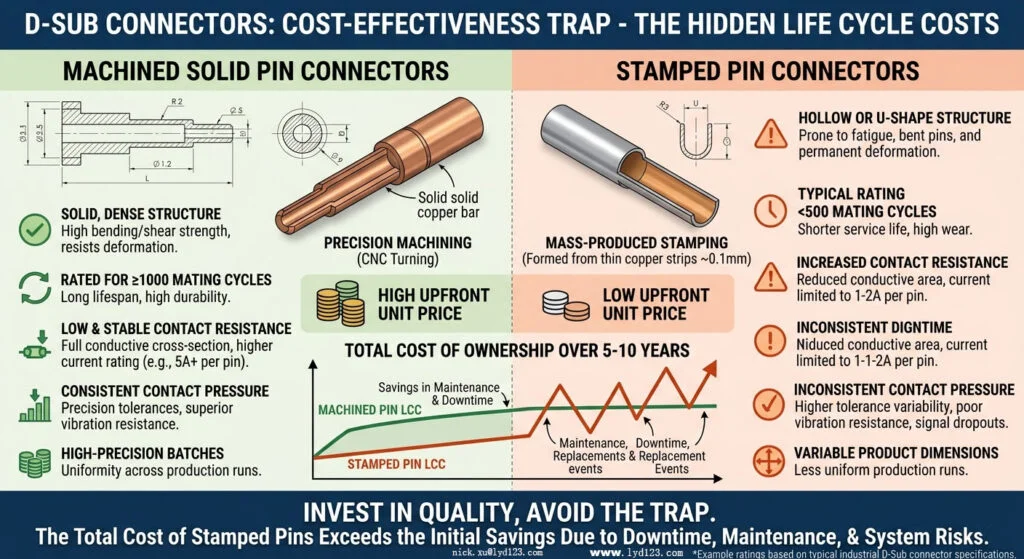
Choosing between machined solid pins and stamped pins is a critical decision in industrial D-Sub connector selection. While stamped contacts offer lower upfront costs, they often hide a ‘cost-effectiveness trap’ in high-reliability applications like automation and robotics.Selecting high-quality D-Sub Connector Contacts is essential for ensuring the long-term reliability of industrial electronic systems.
Frequently Asked Questions
What is the difference between machined and stamped D-Sub pins?
Machined pins are cut from solid metal stock, offering superior durability (500+ mating cycles) and tighter tolerances. Stamped pins are formed from sheet metal, making them more cost-effective for high-volume applications (50-100 cycles).
Which pin type should I choose for industrial applications?
For industrial applications requiring 500+ mating cycles and exposure to vibration, machined pins are recommended. For cost-sensitive consumer applications with limited mating cycles, stamped pins provide adequate performance.
What plating options are available for D-Sub pins?
Gold plating (1u”-30u”) for corrosion resistance and low contact resistance in harsh environments. Tin plating for cost-effective general-purpose use. Selective plating combines gold on contact area with tin on termination.
Machined vs Stamped Pins: Which D-Sub Connector Is Better for Industrial Use?
Core Performance of D-Sub Connector Contacts
The root of the cost-effectiveness gap lies in fundamental differences in manufacturing process, structure, and performance:
Understanding the lifespan of different D-Sub Connector Contacts is vital for high-reliability systems.
| Performance Aspect | Machined Solid Pin Connectors | Stamped Pin Connectors |
|---|---|---|
| Mechanical Durability & Lifespan | Manufactured from solid copper bar via precision turning/CNC machining. Dense, solid structure with high bending and shear strength, resistant to permanent deformation. Rated for ≥1000 mating cycles, ideal for high-frequency use. | Formed by stamping thin copper strips, resulting in hollow or “U-shaped” contacts with very thin walls (~0.1mm). Prone to fatigue and deformation under repeated insertion/extraction. Typical mating cycle rating: <500 cycles. |
| Electrical Performance & Current Rating | Full solid cross-section provides maximum conductive area. Low, stable contact resistance. Uniform, thick gold plating ensures excellent corrosion resistance. Supports high current (e.g., 5A+ per pin) and high-frequency signals without significant attenuation. | Reduced effective conductive area due to hollow structure. Contact resistance can rise rapidly with wear, oxidation, or deformation. Thin gold plating is easily worn away. Typically rated for only 1–2A per pin, unsuitable for high-power applications. |
| Contact Reliability | Precision machining ensures tight tolerances, consistent contact pressure, and excellent vibration/shock resistance. Minimizes the risk of intermittent connections. | Looser dimensional tolerances from stamping lead to inconsistent contact pressure. Spring contacts can fatigue over time, causing signal dropouts in vibrating environments. |
| Manufacturing Consistency | High-precision CNC turning delivers exceptional coaxiality and straightness, with minimal variation between batches. | Stamping processes have higher tolerance variability, leading to inconsistent pin dimensions and spring properties across production runs. |
| Upfront Cost | Higher material and machining costs → higher initial unit price. | Low-cost stamping enables mass production → significantly lower upfront unit price. |
The “Hidden Costs” of Choosing Stamped Pins
The allure of a lower initial purchase price often masks the true cost of stamped pin connectors over the long term:
1 Increased Downtime & Maintenance Costs
Stamped pin connectors are far more prone to failure due to:
Mechanical fatigue leading to broken or bent pins.
Oxidation or wear causing intermittent signal loss.
Poor vibration resistance leading to unexpected disconnections.
In industrial automation, even a single unplanned downtime event can cost thousands of dollars in lost production, labor, and emergency repairs. These costs far outweigh any savings from a cheaper connector.
2 Higher Replacement & Rework Expenses
With a shorter service life, stamped pin connectors require more frequent replacement. For applications requiring soldering or complex wiring, each replacement involves not just the cost of the new connector, but also labor costs for disassembly, rework, and testing. Over 5–10 years of equipment operation, these recurring expenses add up dramatically.
3 Compromised System Reliability & Risk
In critical applications (e.g., medical devices, aerospace, or safety systems), a connector failure can have catastrophic consequences, including product recalls, equipment damage, or even safety hazards. The cost of mitigating these risks far exceeds the initial premium paid for high-quality machined pin connectors.
When Is the “Premium” of Machined Pins Worth It?
While machined pin connectors cost more upfront, they deliver superior value in applications where:
The equipment is expected to operate reliably for 5+ years.
The connector is subjected to frequent mating/unmating cycles.
The application involves high vibration, shock, or harsh industrial environments.
High current (≥3A per pin) or high-frequency signals are required.
Downtime, maintenance, or failure risks must be minimized.
In these scenarios, the full life cycle cost (LCC) of machined pin connectors is significantly lower than that of stamped pin alternatives, making them the more cost-effective choice over the long run.1
Final Verdict: Don’t Fall for the Upfront Cost Trap
Explore Our Connectivity Solutions
www.lyd123.com nick.xu@lyd123.com
📡 Download D-Sub Connector Pin Selection Guide & Request Samples →
Explore our board-to-board connector guide and 2.54mm header guide for more engineering resources.
