

Frequently Asked Questions
What is the difference between XT30, XT60, and XT90 connectors?
XT30 is rated for 15A continuous (30A burst) for micro drones and lightweight robotics; XT60 handles 30A continuous (60A burst) for standard FPV drones and desktop DIY; XT90 delivers 45A continuous (90A burst) for large UAVs, e-bikes, and EV prototypes. Always choose with 20% current headroom for safety.
Can I solder XT connectors without specialized tools?
Yes. XT connectors are designed for hand soldering. Use a quality soldering iron (60W+), pre-tin both the wire and connector cup, and ensure proper heat transfer. The “mate” trick (plugging male/female together during soldering) prevents pin misalignment. Anti-flux caps prevent solder wicking.
Are XT connectors polarity-safe?
XT connectors are genderless and require careful polarity alignment. Always double-check polarity before mating. Use colored wire (red/black) and heat shrink tubing for visual identification. For high-voltage applications (6S+), choose the XT90-S variant with integrated anti-spark protection.
What industrial applications use XT series connectors?
Beyond hobbyist RC, XT connectors are used in industrial battery packs, AGV (Automated Guided Vehicles), electric forklifts, solar charge controllers, portable medical devices, and EV battery management systems where gold-plated low-resistance contacts ensure reliable high-current delivery under vibration.
What wire gauge should I use with XT connectors?
XT30: 18-22 AWG; XT60: 12-14 AWG; XT90: 8-10 AWG. Using undersized wire creates excessive resistance and heat. For industrial cable assemblies, specify silicone-insulated wire for temperature tolerance up to 200°C.
XT Series Connectors Guide: XT30, XT60 & XT90
If you’ve ever dabbled in FPV drones, RC planes, or DIY electric vehicles, you’ve undoubtedly seen those iconic yellow plugs. While they might look like simple pieces of plastic and metal, XT Series connectors are the unsung heroes of the hobbyist world, acting as the reliable “heartbeat” between your battery and motor.
In this post, we’ll break down why these connectors became the industry standard and which one you should choose for your next project.
Why XT Connectors Rule the Market
Before the XT series (developed by Amass), the community relied heavily on Deans (T-plugs). However, XT connectors took over for several key reasons:
- Safety First: Their “sheathed” design means there are no exposed conductive parts, significantly reducing the risk of accidental short circuits.
- Gold-Plated Efficiency: They use high-quality gold-plated banana plugs, ensuring low resistance (<0.3mΩ) and high conductivity across thousands of mating cycles.
- Heat Resistance: Made from high-temperature Nylon (PA66), rated to 120°C continuous, these plugs won’t melt the moment you touch them with a soldering iron.
- Ergonomics: The textured grip and asymmetrical shape make them easy to plug in; anti-spark versions (XT90-S) prevent voltage surge on connection.
Meet the Family: XT30 vs. XT60 vs. XT90
Choosing the right connector is all about balancing weight, current rating, and application environment.
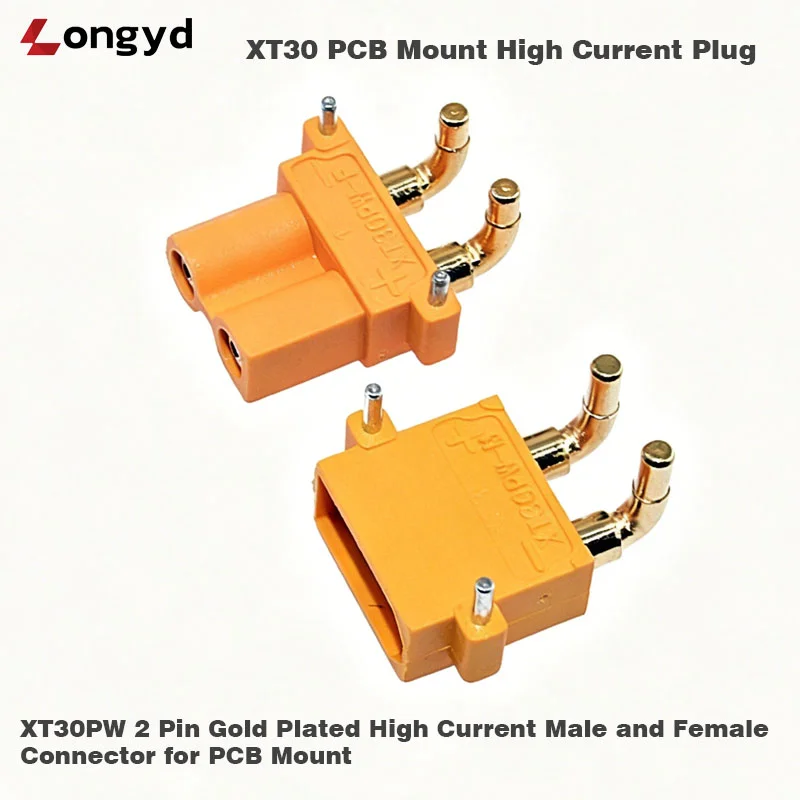
XT30: The Micro Specialist
- Continuous Current: 15A (30A Burst)
- Contact Resistance: ≤0.45mΩ
- Weight: ~1.5g per pair
- Best For: Micro quads (Whoops/Toothpicks), small RC planes, lightweight robotics, portable instrumentation
- Why use it? When every gram counts. Far more reliable than older JST connectors; gold-plated contacts ensure consistent power delivery in high-vibration drone applications.
XT60: The Universal Standard
- Continuous Current: 30A (60A Burst)
- Contact Resistance: ≤0.30mΩ
- Weight: ~4.5g per pair
- Best For: 5-inch FPV drones, 3D printers, mid-sized RC vehicles, solar charge controllers, battery management systems
- Why use it? The “Goldilocks” of connectors — not too big, not too small, capable of handling 90% of hobbyist and light industrial projects. Industry-standard footprint compatible with most battery packs.
XT90: The Heavy Hitter
- Continuous Current: 45A (90A Burst)
- Contact Resistance: ≤0.20mΩ
- Weight: ~9g per pair
- Best For: Large-scale cinematography drones, electric skateboards, high-voltage e-bikes, AGV battery packs, industrial power distribution
- Pro Tip: Choose the XT90-S variant for 6S+ battery applications. Its integrated anti-spark resistor eliminates the dangerous “pop” sound and contact erosion when connecting high-voltage batteries.
Comparison Table
| Model | Continuous Current | Burst Current | Wire Gauge | Contact Resistance | Common Application |
| XT30 | 15A | 30A | 18-22 AWG | ≤0.45mΩ | Ultralight Drones / Small Electronics |
| XT60 | 30A | 60A | 12-14 AWG | ≤0.30mΩ | Standard FPV / 3D Printers / Solar Controllers |
| XT90 | 45A | 90A | 8-10 AWG | ≤0.20mΩ | Large UAVs / E-Bikes / AGV Power Systems |
Industrial Applications of XT Connectors
While XT connectors originated in the hobbyist market, their robust design has led to adoption across industrial sectors:
- Battery Pack Manufacturing: Gold-plated contacts with low contact resistance ensure minimal voltage drop in series/parallel battery configurations for e-mobility and energy storage systems.
- Automated Guided Vehicles (AGV): XT90 connectors handle the high inrush currents typical of AGV motor controllers, with the anti-spark variant protecting sensitive onboard electronics.
- Portable Medical Devices: Reliable, vibration-resistant connection for battery-powered diagnostic equipment and patient monitors where connection failure is not an option.
- Solar & Renewable Energy: XT60 connectors serve as quick-disconnect solutions for portable solar panels and charge controllers in off-grid installations.
Pro Tips for Soldering XT Connectors
Soldering these can be tricky if you’re a beginner. Here are three “Golden Rules” to keep your build clean:
- The “Mate” Trick: Always plug a male and female connector together while soldering. This acts as a heat sink and keeps the internal pins perfectly aligned if the plastic gets too soft.
- Tin Everything: Apply solder to both the wire and the connector cup before trying to join them. Use 63/37 rosin-core solder for best flow characteristics.
- Heat Shrink is Mandatory: Never leave the solder joints exposed. Use high-quality adhesive-lined heat shrink tubing to insulate the connection and provide strain relief against vibration.
Technical Note for Procurement Engineers
When specifying XT connectors for production, verify the following with your supplier:
- Base material: Brass with gold plating (not nickel-plated substitutes)
- Housing material: PA66 Nylon, UL94 V-0 flame rating
- Operating temperature range: -20°C to +120°C
- Mating cycles: ≥1,000 cycles minimum
- RoHS and REACH compliance certification
Final Thoughts
The XT series has earned its reputation through reliability and ease of use. While there are newer connectors on the market (MR series, AS150), the XT30, XT60, and XT90 remain the industry standard for compatibility and proven field performance. For custom wire harness assemblies incorporating XT connectors with specific wire gauges, cable lengths, or overmolding requirements, contact our engineering team for a technical consultation.
www.lyd123.com nick.xu@lyd123.com
📡 Download XT Series Connector Spec Sheet & Request Samples →
Explore our high-current connector guide and wire-to-board selection guide for more engineering resources.
Explore More: DIN Rail Pluggable Terminal Block Header 5.08mm — 5.08mm DIN rail pluggable terminal block headers, 300V 15A, PA66 UL94 V-0. Compatible with 35mm and 15mm DIN rail systems.
