
Introduction: The Critical Role of Precision Connectors in Modern Battery Systems
In the rapidly evolving landscape of energy storage and electric mobility, the 2.0mm pitch blade battery connector with Surface Mount Technology (SMT) has emerged as a critical component for high-density battery pack designs. As industries transition toward more compact and efficient power solutions, these connectors play a pivotal role in enabling reliable, high-current connections between battery cells, modules, and management systems.
This comprehensive technical guide explores the engineering specifications, application scenarios, and design considerations for 2.0mm pitch SMT blade connectors in battery systems, with particular emphasis on their advantages in industrial and automotive applications.
Looking for reliable 2.0mm Pitch Blade Battery Connector SMT for your project? LYD provides high-quality SMT blade connectors with customizable specifications for OEM applications worldwide.
Technical Specifications and Design Parameters
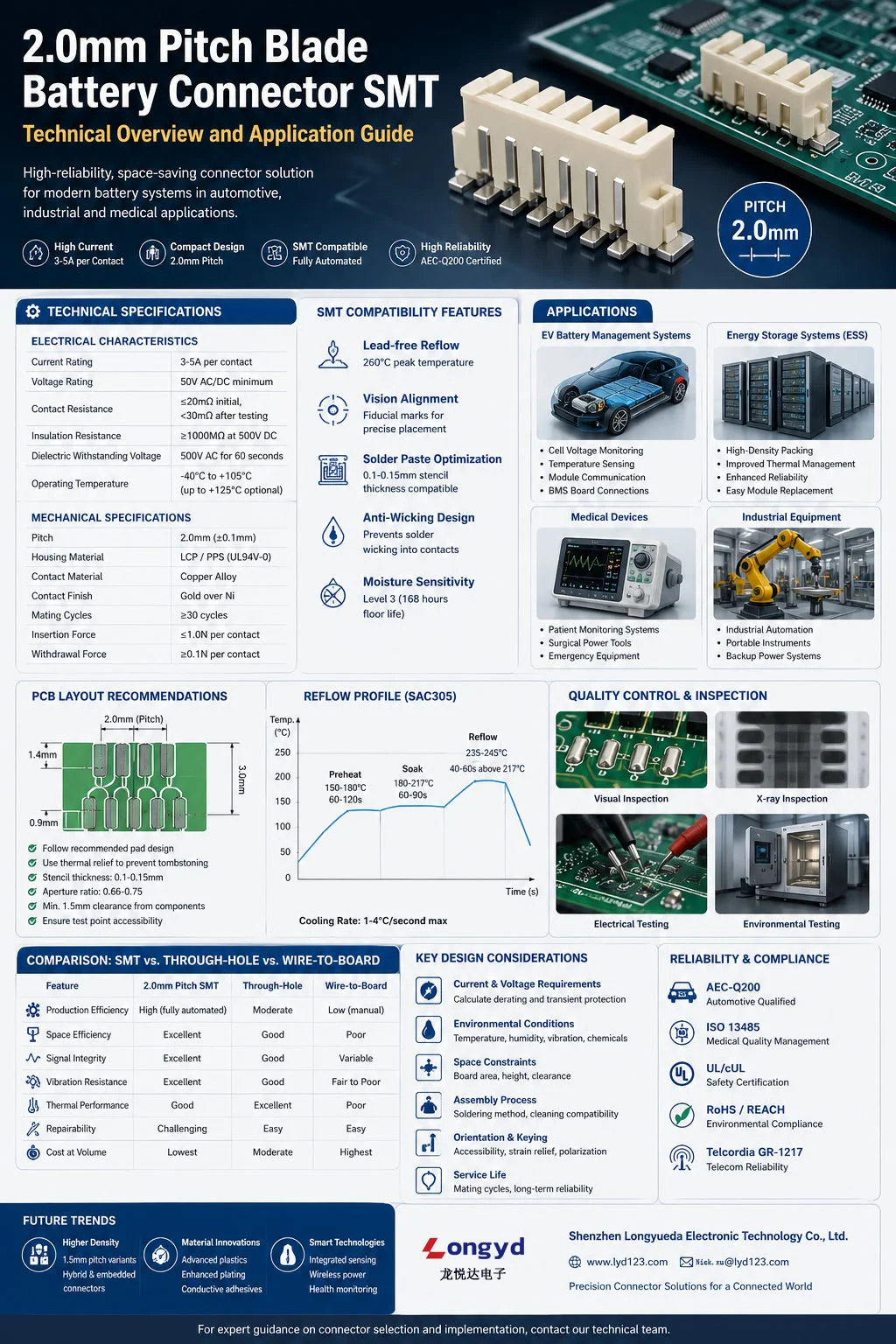
Key Electrical Characteristics
- Current Rating: 3-5A per contact (depending on temperature rise)
- Voltage Rating: 50V AC/DC minimum
- Contact Resistance: ≤20mΩ initial, <30mΩ after environmental testing
- Insulation Resistance: ≥1000MΩ at 500V DC
- Dielectric Withstanding Voltage: 500V AC for 60 seconds
- Operating Temperature Range: -40°C to +105°C (extended options available to +125°C)
Mechanical Specifications
- Pitch: 2.0mm (±0.1mm)
- Housing Material: High-temperature LCP (Liquid Crystal Polymer) or PPS (Polyphenylene Sulfide)
- Contact Material: Copper alloy with selective gold plating (0.76μm minimum)
- Contact Finish: Gold over nickel barrier layer
- Mating Cycles: ≥30 cycles without significant degradation
- Insertion Force: ≤1.0N per contact
- Withdrawal Force: ≥0.1N per contact
SMT Compatibility Features
The surface mount design offers several advantages for automated assembly:
- Standard Reflow Compatibility: Withstands lead-free reflow profiles up to 260°C peak temperature
- Vision Alignment Features: Integrated fiducial marks for precise automated placement
- Solder Paste Volume Optimization: Pad design optimized for standard stencil thickness (0.1-0.15mm)
- Anti-Wicking Design: Prevents solder wicking into contact areas
- Moisture Sensitivity Level (MSL): Level 3 (168 hours floor life at ≤30°C/60% RH)
Application Scenarios and Industry Use Cases
Electric Vehicle Battery Management Systems (BMS)
In modern electric vehicles, 2.0mm pitch SMT connectors serve critical functions:
- Cell Voltage Monitoring: High-density connections for individual cell voltage sensing
- Temperature Sensing: Reliable connections for thermistor networks
- Module-to-Module Communication: Data and power transfer between battery modules
- BMS Main Board Connections: Interface between battery management electronics and power cells
The SMT design enables direct mounting to BMS PCBs, reducing interconnection complexity and improving signal integrity compared to traditional wire-to-board solutions.
Energy Storage Systems (ESS) and Backup Power
For stationary energy storage applications, these connectors offer:
- High-Density Packing: Enables more modules per rack in limited space
- Improved Thermal Management: Direct PCB mounting enhances heat dissipation
- Enhanced Reliability: Eliminates wire fatigue and vibration-related failures
- Serviceability: Quick disconnect capability for module replacement
Portable Medical Devices and Equipment
In medical applications, the compact design and reliability are essential:
- Patient Monitoring Systems: Battery connections in portable monitors
- Surgical Power Tools: High-current connections in battery-powered surgical instruments
- Emergency Medical Equipment: Reliable power connections in defibrillators and ventilators
SMT Assembly Considerations and Best Practices
PCB Layout Guidelines
- Pad Design: Follow manufacturer recommendations for solder mask definition and pad geometry
- Thermal Relief: Implement appropriate thermal relief patterns to prevent tombstoning
- Solder Paste Stencil: Use 0.1-0.15mm thickness with aperture ratio of 0.66-0.75
- Component Clearance: Maintain minimum 1.5mm clearance from adjacent components
- Test Point Accessibility: Provide adequate access for in-circuit test probes
Reflow Profile Recommendations
For lead-free solder processes (SAC305):
- Preheat: 150-180°C for 60-120 seconds
- Soak: 180-217°C for 60-90 seconds
- Reflow: Peak temperature 235-245°C for 40-60 seconds above 217°C
- Cooling Rate: 1-4°C/second maximum
Quality Control and Inspection
- Visual Inspection: Check for proper solder fillets, no bridging or voids
- X-ray Inspection: Verify solder joint quality beneath components
- Electrical Testing: Continuity, insulation resistance, and high-pot testing
- Environmental Testing: Thermal cycling and vibration testing for automotive/industrial applications
Comparative Advantages: SMT vs. Through-Hole vs. Wire-to-Board Solutions
| Feature | 2.0mm Pitch SMT | Through-Hole | Wire-to-Board |
|---|---|---|---|
| Production Efficiency | High (fully automated) | Moderate | Low (manual assembly) |
| Space Efficiency | Excellent (both sides usable) | Good | Poor |
| Signal Integrity | Excellent (shortest path) | Good | Variable |
| Vibration Resistance | Excellent | Good | Fair to Poor |
| Thermal Performance | Good (direct heat path) | Excellent | Poor |
| Repairability | Challenging | Easy | Easy |
| Cost at Volume | Lowest | Moderate | Highest |
Reliability and Compliance Considerations
Environmental Testing Standards
Qualification testing typically includes:
- Temperature Cycling: -40°C to +105°C, 500+ cycles (AEC-Q200 for automotive)
- Thermal Shock: -55°C to +125°C liquid-to-liquid testing
- Vibration Testing: Random and sine vibration per automotive standards
- Mechanical Shock: 50G, 11ms half-sine pulse
- Humidity Testing: 85°C/85% RH, 1000+ hours
- Mixed Flowing Gas Testing: For industrial applications in harsh environments
Industry Compliance and Certification
- Automotive: AEC-Q200 qualification for passive components
- Medical: ISO 13485 quality management systems
- Aerospace: Compliance with relevant MIL standards
- Industrial: UL/cUL recognition, RoHS, REACH compliance
- Telecommunications: Telcordia GR-1217-CORE requirements
Design and Selection Guidelines
Critical Design Factors
- Current Requirements: Calculate maximum continuous and peak currents, considering derating for temperature
- Voltage Requirements: Consider working voltage, transient overvoltages, and isolation requirements
- Environmental Conditions: Assess temperature extremes, humidity, chemical exposure, and vibration levels
- Space Constraints: Evaluate board real estate, height restrictions, and adjacent component clearance
- Assembly Process Compatibility: Verify compatibility with planned soldering processes and cleaning methods
- Connector Orientation: Determine optimal mating direction for accessibility and strain relief
- Polarization and Keying: Ensure proper mating orientation and prevention of incorrect connections
- Service Life Expectancy: Consider required mating cycles and long-term reliability requirements
Reliability Enhancement Techniques
To maximize connector reliability in battery applications:
- Redundant Contacts: Implement parallel contacts for critical power and sensing connections
- Strain Relief: Incorporate mechanical strain relief for cable connections
- Contact Protection: Use protective covers or shrouds in harsh environments
- Solder Joint Reinforcement: Consider underfill for high-vibration applications
- Corrosion Protection: Specify appropriate plating thicknesses for environmental conditions
- Thermal Management: Design adequate heat sinking for high-current applications
Future Trends and Technology Developments
Miniaturization and Higher Density
The ongoing trend toward smaller form factors continues to drive connector development:
- 1.5mm Pitch Variants: Emerging solutions for ultra-compact designs
- Hybrid Connectors: Integration of power, signal, and sometimes fiber optic contacts
- Embedded Connectors: Integration into module housings for reduced assembly steps
Material Innovations
- Advanced Plastics: Higher temperature materials for increased power density
- Enhanced Plating: Alternative plating materials for improved wear and corrosion resistance
- Conductive Adhesives: Development of reliable conductive adhesives as solder alternatives
Smart Connector Technologies
The integration of intelligence into connectors is an emerging trend:
- Integrated Sensing: Connectors with built-in temperature, current, or voltage sensing
- Wireless Power Transfer: Development of contactless charging interfaces
- Health Monitoring: Connectors capable of reporting their own degradation or failure modes
Conclusion
The 2.0mm pitch blade battery connector with SMT termination represents a significant advancement in battery interconnection technology, offering an optimal balance of compact design, manufacturing efficiency, and electrical performance. As battery systems continue to evolve toward higher energy densities and more demanding operating environments, these connectors will play an increasingly important role in enabling reliable, efficient energy storage solutions across automotive, industrial, and consumer applications.
By understanding the technical specifications, application requirements, and design considerations detailed in this guide, engineers and designers can make informed decisions when specifying these connectors for their battery systems, ensuring optimal performance, reliability, and manufacturability throughout the product lifecycle.
For applications requiring expert guidance on connector selection and implementation, our technical team offers comprehensive support from design consultation through production validation. Contact us to discuss how 2.0mm pitch SMT blade connectors can enhance your battery system designs.
For additional information on connector technologies and applications, please refer to our related articles on wire harness connector design and industrial waterproof connector solutions.
Ready to Source Your 2.0mm Pitch Blade Battery Connector?
LYD offers a comprehensive range of 2.0mm Pitch Blade Battery Connector SMT solutions with fast sampling, competitive pricing, and global shipping. Contact our engineering team for technical support and custom specifications.
About the Author: This technical guide was prepared by our engineering team at Shenzhen Longyueda Electronic Technology (lyd123.com), specializing in precision connector solutions for industrial and automotive applications. With over a decade of experience in connector design and manufacturing, we provide technical expertise and reliable products for demanding applications worldwide.