

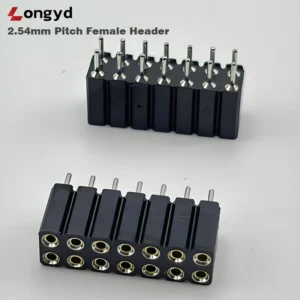
In the realm of high-reliability hardware engineering, a system is only as robust as its weakest physical junction. While the 2.54mm pitch female header is a ubiquitous standard, the engineering nuances behind its material stack-up and contact geometry are what separate a field-ready industrial controller from a prototype that fails after six months of thermal cycling. This guide covers material science, contact physics, and thermal management for engineers specifying 2.54mm female headers in demanding applications.
1. Thermal Management & Reflow Survivability
Modern Surface Mount Technology (SMT) processes demand materials that can survive the rigorous J-STD-020 reflow profile.
Our 2.54mm pitch female header SMT solutions utilize LCP (Liquid Crystal Polymer) or PA9T high-temperature thermoplastics. These materials are selected specifically for their superior Heat Deflection Temperature (HDT). Unlike standard PBT plastics, these polymers maintain structural rigidity even at peak reflow temperatures of +260°C, effectively preventing pin-misalignment and “wicking” issues during high-volume assembly.
2. Contact Physics: The Phosphor Bronze Advantage
In connector engineering, the choice of Phosphor Bronze over standard brass is a calculated decision aimed at maximizing the Mean Time Between Failures (MTBF):
- Elastic Modulus: Phosphor bronze provides superior spring retention. This ensures a consistent Normal Force on the mating pin, maintaining low contact resistance (<20mΩ) even after 100+ mating cycles.
- Plating Engineering: To combat high-vibration environments in Industrial PC (IPC) applications, we offer gold plating options ranging from 1u” to 30u”. This is critical for preventing Fretting Corrosion—the leading cause of intermittent signal failure in harsh environments.
3. Power Density vs. Signal Integrity
Designers often overlook the 3.0A Current Rating. In a high-density 2×40 pin configuration, managing the thermal envelope of the connector becomes a significant PCB trace routing challenge.
Furthermore, these headers are engineered with a 600V AC dielectric withstanding voltage, providing a substantial safety margin for power-sequencing modules and LED driver boards where transient voltage spikes are common. For complementary male header options, see our 2.54mm pitch male header series.
EE Pro-Tip: When designing for Bottom Entry applications, ensure your solder mask clearance accounts for the plastic height (ranging from 3.5mm to 8.5mm) to avoid mechanical interference with passive components on the secondary side of the PCB.
Technical Specifications
| Parameter | Specification |
|---|---|
| Pitch | 2.54 mm (0.1”) |
| Current Rating | 3.0 A per pin |
| Contact Resistance | < 20 mΩ |
| Insulation Resistance | 1,000 MΩ Min |
| Dielectric Withstanding | 600 V AC |
| Operating Temp | -40°C to +150°C |
| Mating Cycles | 100+ cycles |
| Insulator Material | LCP / PA9T High-Temp Thermoplastic |
| Contact Material | Phosphor Bronze (Gold-plated options: 1u” to 30u”) |
| Entry Direction | Top / Side / Bottom |
| Mounting Type | SMT (Surface Mount Technology) |
| Compliance | RoHS / REACH / J-STD-020 |
Frequently Asked Questions
What is the difference between a 2.54mm female header and a male header?
A female header has recessed sockets that accept the pins of a male header. In a wire-to-board configuration, the female header is typically soldered to the PCB while the male header is crimped to wires. The 2.54mm pitch is the industry-standard 0.1-inch grid spacing, making it breadboard-compatible and widely used for prototyping and production.
Why choose LCP over standard PBT for the insulator?
LCP (Liquid Crystal Polymer) offers a higher Heat Deflection Temperature (HDT) compared to PBT, allowing it to survive lead-free reflow profiles at +260°C without deformation. LCP also provides lower moisture absorption and better dimensional stability, which is critical for maintaining consistent pin alignment in high-volume SMT assembly.
What is the maximum current rating for a 2.54mm pitch female header?
The standard current rating is 3.0A per pin. However, the actual current capacity depends on the number of pins, ambient temperature, and PCB copper trace width. Derating to 80% (2.4A) is recommended for continuous operation at elevated temperatures.
What gold plating thickness should I choose?
For standard consumer applications, 1u” to 3u” gold plating is sufficient. For high-vibration industrial or automotive environments requiring 100+ mating cycles, 15u” to 30u” gold plating is recommended to prevent fretting corrosion and maintain low contact resistance over the product lifespan.
Can I use the same footprint for top-entry and bottom-entry headers?
No. Top-entry, side-entry, and bottom-entry headers have different plastic heights (3.5mm to 8.5mm) and pin alignment. Always verify the mechanical drawing and adjust the solder mask clearance accordingly to prevent interference with bottom-side components.
Conclusion: Designing for Reliability (DfR)
Whether you are building Smart Home Modules requiring high spatial efficiency or Precision Instrumentation that demands repeatable accuracy, the 2.54mm pitch female header is your primary mechanical interface. By specifying LCP-based housings and high-micron gold plating, you are not just passing a power-on test—you are designing for the entire product lifecycle.
📡 Download 2.54mm Female Header Datasheet & Request Samples →
Explore our comprehensive wire-to-board connector selection guide and our board-to-board connector guide for additional interconnect solutions.
